Behind the Scenes: See Mommy Work!
I feel very lucky to have wonderful customers and my business has grown exponentially through lots of hard work. I get questions and comments regarding my business a lot so here’s a look at my work and my thoughts about it all.
Q: How do you find the time to do it all?
A: I work around my kids’ schedules. That means nothing happens until after 9am when they are at school. Between 9-3 pm, I manage to clean the house, grocery shop, run errands, go to school for activities and conferences, take them to doctors’ appointments and fulfill my orders. Then the 3 pm -8 pm is filled with school pickups, homework, making dinner, pleading with them to eat their fruit and veggies, showers, and bedtime. I work again from 8pm until needed — and for the last week, it meant staying up til 2 am! I. love. my. work!
Q: How did you start your business?
A: I had a near-impossible time sourcing high quality metal purse frames for my clutches. They were shipped from overseas which took 2-3 weeks, and would come scratched, or they would open/close properly … a complete hassle! It was not a reliable way to do business as a serious and professional handbag maker. So I did 8+ months of research and contacted lots and lots of manufacturers. After many samples and false starts, my husband and I took the plunge and made an investment in becoming a wholesaler. I have my own manufacturer that I work with though I am looking to add another manufacturer to spread out the production as my business has grown. It’s a BIG investment. There’s a high barrier to entry. One just doesn’t start producing these things. You have to have engineering done, CAD drawings, specs done, samples done, source your raw materials, forecast inventory so you can have a productions schedule … it’s a lot of work. I am a WHOLESALER. I am not a retailer who buys from other wholesalers, mark up the price to make money and sell it at retail. You are buying my frames, made from my designs, using my own molds, with my own specifications on size, width, closures, raw materials, etc… And I don’t sell to resellers either. I sell directly to the end-user, the ladies (and some gents) who make their own clutches whether they are a professional (500+), a hobbyist (1-20) or anyone in between growing their business.
Q: How do you have such high quality metal purse frames?
A: I hand inspect everything myself, each single frame, before I fulfill a customer’s order. So, at nights when I’m watching LOST or The Office, I’ve got a box of frames to go through. Did you know that there are always defects in a batch of goods? U.S. manufacturers typically make 10% more of the order to accommodate the expected defects. So yes, even with laser-eyes to assist in quality control, nothing beats my pair of hands to open and close the closures to get the *click* that I’m looking for. Since I have a 100% refund guarantee, I do NOT want any returns due to defects. That costs me money. That costs my customers valuable time! So I have ZERO defects. ZERO. It’s more expensive to get a new customer than it is to keep one. So I do all that I can to get and keep all my customers, and the main way is to ensure that I have the best quality product.
Q: Will you carry more sizes/styles/finishes?
A: To start carrying a new size, style, or finish is an expensive up-front cost and time-consuming. It’s easy if I know the market is in need of it and there’s enough demand. But first I have to do a market analysis. Is there a need? What is the potential demand in terms of quantity? How much would customers pay for it? How much will it cost per unit for me to produce it? Since I have an established relationship with my manufacturer, I have reduced the time it takes to get the product to market but the process is still the same … CAD drawings, samples, raw materials resourcing (prices of metals fluctuate in the marketplace), quality control… I do have an advantage that I can start with a relatively smaller batch than most so if I have a couple of customers who want and will take 300-500 of a size, I can go ahead and make that new size knowing that the surplus will probably be sold to the general hobbyists market.
Q: What does your studio look like?
A: I have 2 offices. One is for the creative aspect and one is for production. I’m not going to show you the production room, since it is just filled with metal purse frames, tissue paper, tape, lots of boxes in many sizes, postage scale, etc…. The creative office is a mess right now, but I’ll show you a clean corner. I’m in the midst of re-organizing it but I’ve come to realize that I need the creative separate from the production. So in my creative office, I have lots of fabric, and inspirational things. I also have my beautiful fine jewelry business in there and a photography station to take jewelry photos. It’s all about creating in that office. Here’s a pic.

The clean side!
Tips: Gutermann glue for your clutches
The miracle that is Gutermann glue. I cannot say enough about this little worker. When I first made clutches, I have tried many domestic-brand glues and they either took too long to set/dry, failed to provide adequate adhesion, or too viscous. It killed me when I had to throw away the clutch in the final stage of gluing it to the metal purse frame. Oh, the mutiny! Pirates had nothing on me!
If you’ve never worked with Gutermann glue before, you should know:
*It’s viscosity is similar to cement glue that is new. In fact, get some excess on your metal purse frame and you can “roll” and “ball” it up/off just like rubber cement. However, if you have a tiny excess and there’s not enough glue there to “ball up” and roll off, it will appear as a thin film on the metal frame. Simply use your fingernail to gently scrape it off. NEVER use an abrasive pad: you don’t need to and you will scratch your metal purse frame. *shriek*
*It sets quickly reducing your production time. I recommend doing only one side at a time and waiting 10 minutes per side for it to set. But in my own production (since I’ve made many clutches and produce many at a time), I glue the entire frame (both sides) at the same time. I made a mistake one time and tried to take out the fabric to reposition it after 2 hours, and I could NOT remove it. (There went that beautiful clutch…) It’s on for good!
*It doesn’t penetrate your skin. It will dry and you will peel it off. Freakily, that is one of my favorite things to do!
*There is no warning about carcinogens in the glue, unlike other industrial glues. My husband’s mom, dad, and 3 sisters had/have cancer and he works in Oncology so this is very important to me as I work with it daily.
*When you take the cap off, put the cap upside down on the table so that you can quickly reinsert the tube back into the cap and screw the cap back on. This is especially important on a full tube as the glue just wants out.
*Until you get used to making clutches, start your gluing in the corner of the frame where it’s the widest and needs the most glue. When you open the glue tube for the first time, a bead will quickly form at the tip and expand as the glue comes out. So be sure to have your frame at the ready! The tube has a nicely tapered end that allows you to put the glue in the frame channel nicely. This tip is especially useful for medium- and smaller-sized frames as their channels are smaller.
*Before you store away your glue, wipe off excess around the tapered tip. If you forget, no worries, you can just peel it off before your next use!
*Compared to other industrial glues, I feel that this one is much lower in odor. But as a flammable product, it does have that industrial glue aroma, so you can open a window for ventilation if you’re at all bothered by the glue scent. I work with it daily, in the heat of summer, in the warmth of my workroom during a cold winter and I’ve never even cracked a window open. For storage, I’ve stored it year-round on my shelves in my regular-temp workroom. No additional precautions needed but I wouldn’t put it in a hot garage in the middle of a southern summer.
This glue is like liquid gold to me. It really solved my problem of attaching it to the frame. However, I also use it for quick fixes like hemming my kids’ clothes when I don’t have the time. I have also used it around the house for other gluing needs instead of Gorilla glue, Crazy glue, wood glue … I just carry it around everywhere!

Gutermann glue for metal purse frames!
What’s the lead in these metal purse frames?
One technical question that I get asked by my potential buyers is “does the lead content meet (my state’s) standards?” And it’s usually from someone in California. California is known for its forward-thinking and tough standards on a lot of legislation affecting the environment, such as lead and pesticides. Federal standards sometimes trail behind California on these types of regulations.
While metal purse frames does not have its own testing and certification requirements, it does need to meet the federal lead standards and guidelines. As per the Consumer Product Safety Commission, it does require it for other products, most recently those intended for use by children 12 years old and younger. Moreover, small retailers or sellers who resell used children’s products are not required to test and certify. Nonetheless, lead level must not exceed 300 ppm. For more information, please go to cpsc.gov.
That said, my biggest market is California. My “nickel-free metal purse frames(TM)” are tested for lead at 90ppm and meet the US.’s lead standards. So you can be assured of not only the high quality of my nickel-free frames (another topic for a post later), but also of the safety by the testing and low level of lead.
You need fiber – just not on your metal purse frame!
I’m all about fiber, especially for women! But just not on my metal purse frame. In my search of finding a good metal purse frame supplier for my clutches, I ran into quite a few snafus. This is one of them.
Sorry for the blurry picture, but you get the idea! You can rest assure that my “nickel-free metal purse frames(TM)” do not have embedded fibers like this. This can happen in the oh-so-important coating process where stray fibers in the air can land and die on your frame. That’s why you need a dust-free pristine environment — just like those Silicon-Valley-chip-makers!

The importance of fiber!
A shiny new coat for your metal purse frame
Who doesn’t love a shiny new coat? Regardless of season, your metal purse frame should always have a shiny new coat. But sometimes in the critical coating process, things can go wrong.
This post addresses the milky and cloudy appearance that can happen to the coat of your metal purse frame during the coating process. That’s why it’s so important that you buy from a supplier who can do good quality control during the making of it. The most important and last step is the final inspection done by the human eye, not some machine that just sends it down some conveyor belt only to eventually end up in your lap.
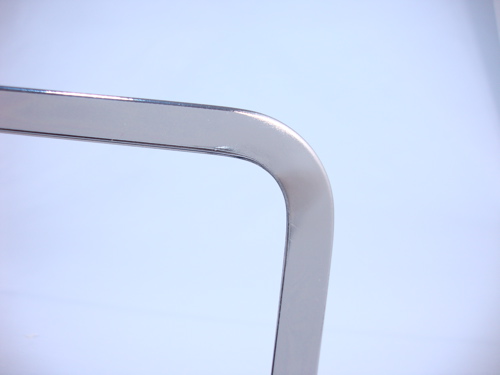
Milky appearance on the corner

This whole arm is cloudy!
This one below is what you want: shiny, spankin’ new “nickel-free metal purse frame(TM)”

Look at me! I'm practically gleaming with pride!
Where to buy “nickel-free metal purse frames(TM)”: whilebabynaps.com or whilebabynaps.etsy.com.
Nickel frame gotcha feeling gray?
Know your metals! Not all “nickel purse frames” are alike. Like everything else that is made, there’s going to be some defective ones in the batch.
This post deals specifically with the gray or smokey discoloration that can occur on the nickel frames.

Gray discoloration due to bad coating
Sometimes you can get a bad one where the surface coating wasn’t done right. The result is a useless nickel purse frame. These gray streaks cannot be rubbed off as they are permanent errors that happened in the coating and drying process. Here’s a couple more samples of nickel frames that may leave you feeling gray…
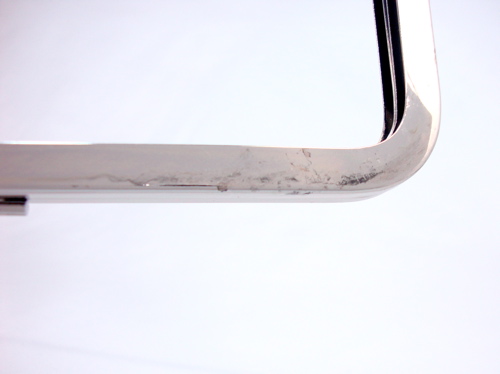
Streak of bad luck?
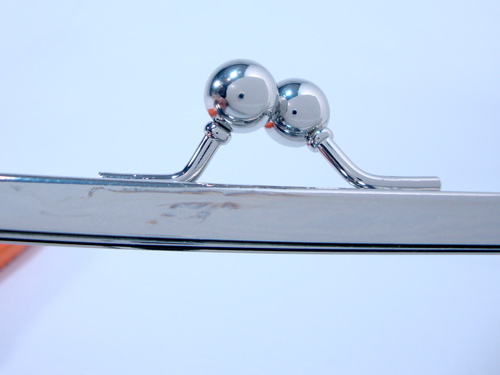
Minor yet noticeable, and ultimately, unuseable!
Kiss my kisslock!
If you’ve never worked with metal purse frames before, it may seem that one nickel purse frame is the same as the next one. But that is not so. It really depends on your supplier so make sure you get all your information before you buy it. After all, all your hard work in making the soft materials for your clutch may be ruined if you don’t have the right hard material – your metal purse frame.
This post deals specifically with the kisslock closure.
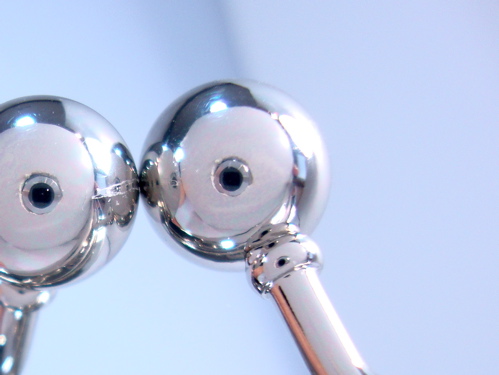
Too tight
Notice how the kisslock closure scratched after one attempt at opening and closing. This is because of the poor setting that exceeded the allowable measurements. Not only does it damage the closure, it also hurts the fingers!
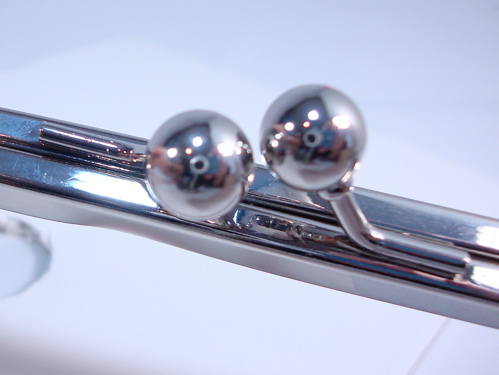
Too loose
The focus is off on this picture, but nonetheless, it does show how this also exceeded the allowable measurement and resulted in a closure that won’t close!

It seemed fine but ....
This is one of those that you won’t know until it’s too late … it looks like its fine but as you can see, it doesn’t have a tight fit even though the kisslock closures seem to line up well.
How can you avoid purchasing these?
1) work with a supplier who has a good refund/replacement policy. Never buy from suppliers who will not accept 100% refund for defective frames.
2) work with a supplier who has good feedback from their customers. Check their feedback. Ask for testimonials or references.
3) work with someone locally. If you are working on your clutch and your frame is defective, you will need a quick replacement so that you aren’t waiting 3 weeks for a replacement.
About
I am the #1 US seller of purse frames and I’ve been incorporated since 2001. This blog is mainly aimed at my audience of clutch handbag makers. I have a very small niche that is comprised of 99.9% women. I am loyal and promote handbag makers who are loyal to me by using my fine purse frames. When they are successful, then I am successful.
The two businesses that I own are:
*purse supplies, Gutermann glue, and DIY clutch kits at whilebabynaps.etsy.com, whilebabynaps.com
*up-cycled purse supplies PurseFramesOutlet.etsy.com
To find clutches made using my fine metal purse frames, LOOK to see “Trademarks of WhileBabyNaps.com and H&D LLC” and you’ll know the clutches are made using the finest metal purse frames that are tested for lead and that have a protective coating to lengthen the life of the clutch. You can go to any of the sellers on the Sellers page.
****NOTE: If you want someone to make a clutch for you, please contact any of my sellers and inquire. They will gladly make custom orders!****
Interested in reaching my audience? Advertise. Contact me here.
Thank you for stopping by for a look.

Warmly,
Thy Khuong
-

My Etsy shop

#1 US Seller of Purse Frames
My Main shop

Wholesale purse frames for clutches
Grab My Blog Button
 <a href="http://www.whilebabynaps.etsy.com" target="_self"><img src="https://clutchme.files.wordpress.com/2012/10/etsy-shop-button.jpg" alt="WhileBabyNaps" width="150" height="150" /></a>
As Seen…

Your Ad here


 Clutch-Me.Com